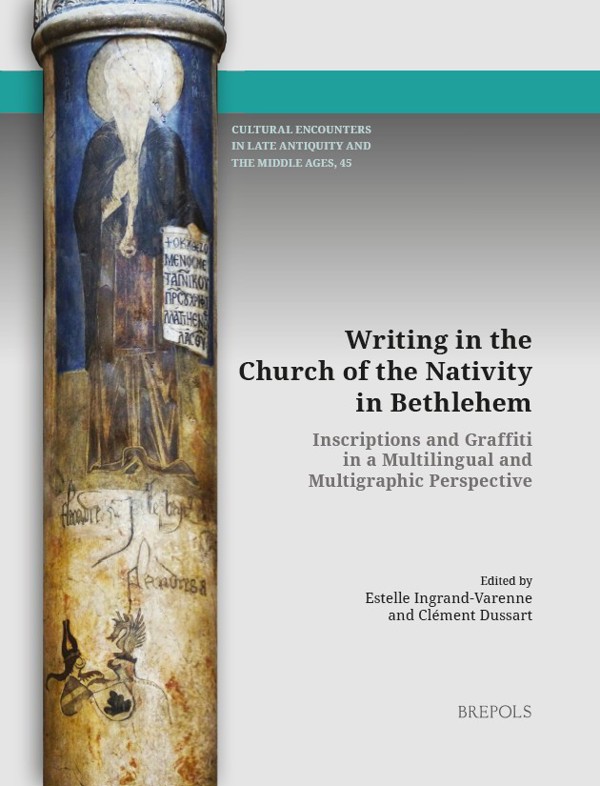
Estelle Ingrand-Varenne, Clément Dussart (eds)
Turnhout, Brepols, 2026 (Cultural Encounters in Late Antiquity and the Middle Ages, vol. 45
272 p.
E-book
Link: https://www.brepols.net/products/IS-9782503619798-1
Abstract:
The Church of the Nativity in Bethlehem is an exceptional epigraphic site. The major restoration campaign (2013-2020) and the recent bibliography dedicated to this building allow us to question hundreds of inscriptions and graffiti which appear on the mosaics, paintings, and walls of this shrine built on the presumed birthplace of Christ. The site exhibits a graphic symphony – if not cacophony – in Latin, Greek, Arabic, Syriac, Armenian, Georgian, Slavic, and Rus scripts, made by pilgrims and travellers as well as the authorities and the different religious communities over the centuries.
The goal of this book, which gathers epigraphists from different backgrounds, as well as historians, art historians, and restorers, is to approach those writings under different angles. Which typologies of graphic acts are uncovered and can we escape from the labels ‘graffiti’ and ‘inscriptions’? What purpose do they serve? With which materials and using which techniques where they created and by whom? Where were they located in the complex of the Church, which includes the caves, the cloister, and the monastic buildings? This study explores the stratigraphy of the writings and offers several plans detailing their distribution, revealing a new chapter in the history of the building, in its use by pilgrims. It highlights the various actors in epigraphic communication and the interactions between these graphic acts in the different writings and languages. All these inscriptions and graffiti contribute to building up a full picture of the rich heritage offered by this unique holy site.


